Four-man Space X Crew Dragon spacecraft wraps up six-month stay in orbit_我的网站
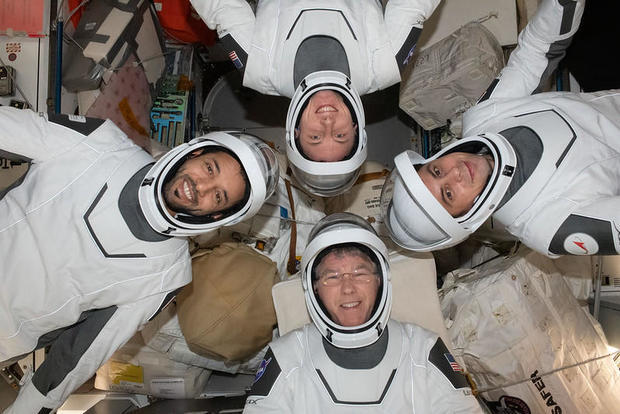
A | Two NASA astronauts, a Russian cosmonaut and a United Arab Emirates astronaut undocked from the International Space Station Sunday and headed for an overnight splashdown off Florida's East Coast early Monday to wrap up a six-month stay in orbit.Strapped into their SpaceX Crew Dragon "Endeavour" spacecraft, Crew-6 commander Stephen Bowen, pilot Woody Hoburg, cosmonaut Andrey Fedyaev and UAE crewmate Sultan Alneyadi undocked from the station's forward Harmony module at 7:05 a.m. ET to kick off a 17-hour flight back to Earth.Crew-6 (clockwise from top): Pilot Woody Hoburg, cosmonaut Andrey Fedyaev, commander Stephen Bowen and United Arab Emirates astronaut Sultan Alneyadi. NASA "Before we get busy, we just want to say wow!" mission control radioed a few minutes before undocking. "Can you believe it's already time to leave? We can't. ... You've done an incredible job, and to say it's been a pleasure to support you guys in this mission would be an understatement." "Thank you very much," Bowen replied. "It's been a real pleasure and an honor to be here for this expedition. We're coming up on 23 years of continuous occupation of the International Space Station, which is absolutely amazing. Just a real privilege to be a part of it."If all goes well, the Crew Dragon will execute a 16-minute de-orbit thruster firing starting at 11:24 p.m. ET. The "burn" will slow the spacecraft by 252 mph, just enough to drop it back into the lower atmosphere on a southwest-to-northeast trajectory.
Splashdown in the Atlantic Ocean east of Jacksonville, Florida, is expected at 12:17 a.m. ET Monday."We're definitely looking forward to our return, and for me as a rookie flyer, the final part of that unique life experience (of) decelerating from 17,500 miles an hour down to hopefully a great splashdown," Hoburg said last week.A SpaceX team will be standing by to pull the spacecraft aboard a company recovery ship and assist the crew members getting out of the cabin as they begin readjusting to the unfamiliar tug of gravity after a half year in weightlessness.Before departing the space station, Bowen, a former submariner, said he most looked forward to "the nice ocean air and peaceful calm seas. That'll be really nice to get back to."
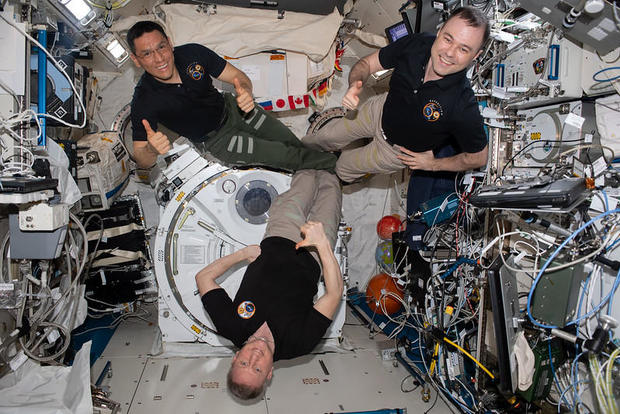
Hoburg said he was looking forward to a "real shower." Alneyadi said he couldn't wait to rejoin friends and family, along with enjoying "a real hot cup of coffee." As for Fedyaev, "I think my dream is a bed for good sleeping. I can lay on one side. Another side. My back. Sleeping!"After initial medical checks aboard the recovery ship, all four fliers will be flown to shore by helicopter. A NASA jet then will carry them back to Houston and the Johnson Space Center for debriefing and reunions with friends and family.Left behind in orbit were three Soyuz crew members -- station commander Sergey Prokopyev, Dmitri Petelin and NASA astronaut Frank Rubio -- and four Crew Dragon fliers launched August 26 to replace Bowen and company: Crew-7 commander Jasmin Moghbeli, European Space Agency astronaut Andreas Mogensen, Japanese astronaut Satoshi Furukawa and cosmonaut Konstantin Borisov.NASA astronaut Frank Rubio, upper left, Soyuz commander Sergey Prokopyev, upper right, and flight engineer Dmitri Petelin will close out an extended yearlong mission when they return to Earth on September 27. Rubio will set a new record for the longest single flight by an American astronaut. NASA Prokopyev, Petelin and Rubio were launched to the station last September and are wrapping up a marathon 371-day mission.They originally planned to spend six months in space, but their Soyuz ferry ship was disabled by a major coolant leak last December. The Russians opted to send up a replacement spacecraft, and the crew's mission was extended an additional six months.A fresh Soyuz crew — commander Oleg Kononenko, Nikolai Chub and NASA astronaut Loral O'Hara — is scheduled for launch from the Baikonur Cosmodrome in Kazakhstan on Sept.15.Prokopyev, Petelin and Rubio will undock and return to Earth 12 days later. In so doing, Rubio will set a new U.S. record for the longest single spaceflight by an American astronaut.
Launched atop a SpaceX Falcon 9 rocket on March 2, the Crew-6 fliers will have spent 185 days and 22 hours off planet, circling the globe 2,976 times while traveling 78.9 million miles through space. At splashdown, Bowen, the only space veteran on the crew, will have logged 227 days in space across four missions.Over the course of their mission, the Crew-6 astronauts welcomed seven visiting vehicles, including two unpiloted Cargo Dragon spacecraft, two Russian Progress supply ships, a Northrop Grumman Cygnus cargo carrier and two piloted Crew Dragons.They also carried out three spacewalks. Bowen and Hoburg ventured outside twice to install new roll-out solar blankets and Alneyadi joined Bowen for a third excursion to retrieve a failed antenna package and to carry out other maintenance."It's certainly been the experience of a lifetime, and a real honor to get to spend six months, six incredibly short-feeling months, living and working aboard this incredible orbiting outpost," Hoburg said before departing the station. "I think we got a lot done."
Bill Harwood has been covering the U.S. space program full-time since 1984, first as Cape Canaveral bureau chief for United Press International and now as a consultant for CBS News. He covered 129 space shuttle missions, every interplanetary flight since Voyager 2's flyby of Neptune and scores of commercial and military launches. Based at the Kennedy Space Center in Florida, Harwood is a devoted amateur astronomer and co-author of "Comm Check: The Final Flight of Shuttle Columbia."
Zhou Jiang speaks at an event. Photo: Courtesy of Zhou Jiang Zhou Jiang, a researcher at the Sichuan Academy of Social Sciences, has a favorite book: White Deer Tableland or Bai Lu Yuan by renowned writer Chen Zhongshi. As vice president of the Regional Science Association of China (RSAC), Zhou told the Global Times that a lifetime of reading has profoundly shaped the way he sees and understands the world. It ultimately led him to a career in research and academia, where he teaches and pursues scholarly work. Since earning his PhD in economics in 2000, he has devoted himself to the study of regional science and economics, a field that demands a constant crossing of disciplinary boundaries, drawing on the fields of geography, sociology, history, and ecology among others. "Reading has kept alive my sense of curiosity and taught me to ask questions with patience and persistence: Where do disparities in regional development come from? How do policies affect different groups in society? And how can a region pursue both efficiency and equity so that development is not merely effective, but also imbued with a greater sense of humanity and warmth?" Zhou noted. Founded in 1991, RSAC is a national academic society dedicated to advancing domestic and international academic exchange and cooperation, providing consulting services on spatial planning, urbanization, and regional development, and offering intellectual support for China's modernization drive. The 57-year-old researcher noted that reading has empowered him in two distinct ways. "The first is discernment. When confronted with a complex issue, I try not to settle for a simple conclusion. Instead, I make an effort to understand its broader context, how it has unfolded, and the perspectives of the different people involved," he said. "The second is a sense of inner steadiness. Setbacks are an inevitable part of both life and work. Good books remind us that hardship is never ours alone to bear; countless people before us have faced circumstances more difficult than our own, made difficult choices, and found the strength to carry on. Reading cannot solve every problem for us, but it can help us remain calm when challenges arise, giving us the clarity and resilience that allow us not to panic or give up too easily," he said. Historical depth
Each time Zhou returns to the White Deer Tableland, he finds something different in its pages. "When I first read it as a young person, I was drawn primarily to the characters and the twists and turns of their lives. Later, as I began researching regional economics, I found myself paying closer attention to the changes in the land, the countryside, families and social order presented in the story. Now, approaching 60, I have come to appreciate more deeply the choices the characters make, the constraints they face, and the quiet perseverance they show amid the sweeping currents of their times," he said. White Deer Tableland uses Bai Lu village in Northwest China's Shaanxi Province as a microcosm, tracing the feuds and intertwined fortunes of three generations of the Bai (literally meaning white) and Lu families. Through their stories, it captures more than half a century of sweeping historical change, from the final years of the Qing Dynasty (1644-1911) to the 1970s and 1980s. The novel won the Mao Dun Literature Prize, one of China's top literature awards, in 1997. Zhou prefers literary works with historical depth and a keen eye for social change. Regional economics may appear to be concerned with the spatial distribution of industries, population and resources, but at its heart, it is about how people live on a particular piece of land, and why some places flourish while others decline, he noted. In this sense, literature and history are more than pastimes beyond professional research. They often help him understand the historical context, cultural traditions and social mentality that lie behind economic data, he said. When reading novels, Zhou said that he often pays close attention to the relationship between people and the places they inhabit: How the land shapes the local character, how transportation transforms a region, and how shifts in industry reshape families and villages. Such details may not offer a direct conclusion, but they broaden a researcher's perspective. They also serve as a reminder that research should look beyond growth rates and statistical indicators to consider the sense of fulfillment experienced by ordinary people and the dignity of human beings. Understanding ourselves Once, while tidying his study, he came across a book filled with notes he had scribbled in his early years. Among them was a question that particularly caught his attention: "In the face of sweeping changes in the times and profound social transformation, what can a person truly determine for himself?" Looking at those words he had written in his youth was like coming face to face with the person he had been decades ago. Reading is not simply the act of understanding a book; it is also a record of a person's own growth, he said. The same book can reveal something entirely different when read at different stages of life. When we are young, we turn to books in search of answers; but when we become seasoned, we read more to understand life, to understand others, and ultimately, to better understand ourselves, Zhou said. In this era of fragmented information, AI can help people access information quickly, organize materials, and gain a basic understanding of unfamiliar fields. Yet deep reading, Zhou said, allows people to see how a conclusion is reached — what evidence supports it, where its boundaries lie, and what alternative interpretations it may invite. What truly shapes a person, after all, is not how much information they have browsed, but the words that have made them pause and reflect - and the words that have remained with them for many years, he added. 。
Current article:http://bll.laonenpeidiebenhuaiyunnangshi.cfd/list_8bd8l/vkq.html